

Fund the FTC
Congress should do more to invest in consumer protection and antitrust enforcement

As some of you know, I served at the Federal Trade Commission (FTC) last year before returning to American Principles Project in February.
My time at the FTC was incredible. I made lifelong friends, learned a great deal about antitrust and consumer protection enforcement, and received a once in a lifetime opportunity to support Chairman Andrew Ferguson’s important work at the agency. I also met dozens of civil servants who were exceptional at performing their jobs and took seriously the agency’s mission of protecting American consumers from anticompetitive, deceptive, and unfair business practices. It was one of the best years of my career.
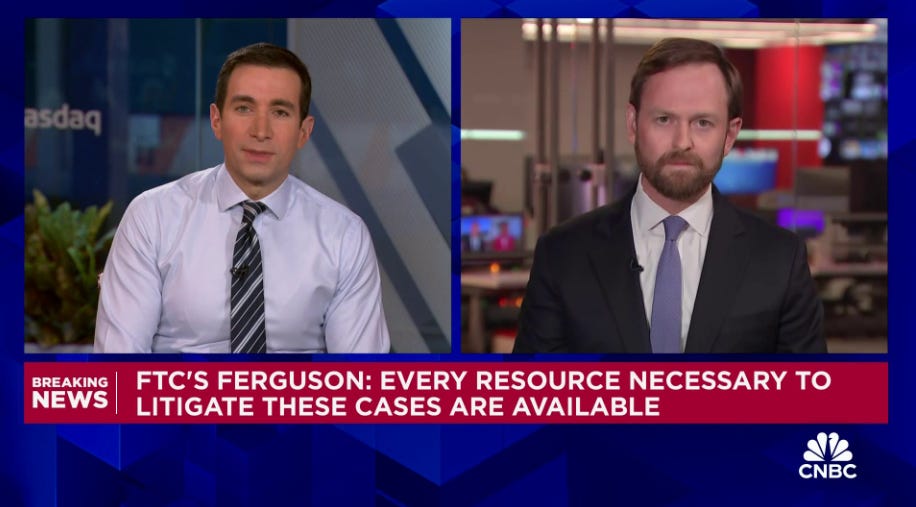
A lot of people have asked me about Ferguson. First of all, I can’t speak highly enough about his character. He says what he means and means what he says. But he is also extremely talented. Not only is he a brilliant lawyer and litigator, but he has a great political acumen. Throughout his time as FTC Chairman, he has demonstrated an impressive ability to navigate a complicated political landscape, while maintaining a tough enforcement posture across the board. His success in leading the FTC is why the White House recently tapped him for a second job, asking him to serve as Vice Chair of its critical Task Force to Eliminate Fraud.
One of my big takeaways from my time at the FTC is that, while the agency has been extremely effective under Chairman Ferguson’s leadership, it could still use more resources from Congress. Recent cuts to the FTC’s FY2026 budget have undeniably had an impact on the agency’s capacity, despite the Chairman’s best efforts to maximize every dollar. Meanwhile, Congress is asking the agency to do even more, as Republican staffers seemingly become more aware of the FTC’s impressive consumer protection authority under Section 5 of the FTC Act.
Now, Congress is preparing to decide on the agency’s FY2027 appropriation. In his budget, President Trump requested that the FTC return to its FY2025 funding amount — a full $427 million. But last month, the House Financial Services and General Government Appropriations Subcommittee chose to maintain FTC funding at its FY2026 level of $384 million.
That’s too low. We can do better. And we should want to do better because ultimately that appropriation yields an extremely high return on investment. Even fiscal conservatives should be able to see why investing in the FTC is such a value play, especially with Chairman Ferguson at the helm.
Last month, American Principles Project penned a letter to congressional appropriators calling for a significant increase in FTC funding — to $575 million for FY2027. We were joined by individuals representing seven other center-right organizations. The letter goes over the Chairman’s record in detail and explains why investing in the agency is good for consumers and smart politics.
I’ve included that letter below:
March 13, 2026
The Honorable Tom Cole
Chair, House Committee on Appropriations
H-307 The Capitol
Washington, DC 20515
The Honorable Susan Collins
Chair, Senate Committee on Appropriations
S-128 The Capitol
Washington, DC 20510
Dear Chairman Cole and Chairwoman Collins:
We, the undersigned conservative leaders and organizations, write to urge you to prioritize a meaningful increase in funding for the Federal Trade Commission (FTC) in the FY2027 appropriations process. Specifically, we request an appropriation of $575 million, which would allow the agency to take on more work both to protect the public from deceptive and unfair trade practices and from unfair methods of competition and also to deliver even greater value to American consumers and taxpayers.
While conservatives rarely advocate for larger budgets for government agencies, we believe the Federal Trade Commission qualifies as a notable exception because of its ability to yield an exceptional return on investment. Under the strong, principled leadership of Chairman Andrew N. Ferguson, the FTC has transformed into a true profit center for the federal government and for consumers. Last year, the FTC secured a historic $2.5 billion settlement with Amazon, resulting in $1.5 billion in direct refunds to millions of harmed consumers, and $1 billion in civil penalties paid directly to the U.S. Treasury. This single settlement covered the FTC’s entire FY2025 budget multiple times over.
But this is what we have come to expect during Chairman Ferguson’s tenure: victory after victory for American consumers and workers. Earlier this year, the FTC and Walmart agreed to a $100 million judgment to settle allegations that Walmart had deceived its delivery drivers about compensation by showing them inflated base pay and tip amounts. And last December, the FTC secured a $60 million settlement from Instacart requiring it to cease its deceptive practice of secretly signing up customers to its premium subscription service.
In the housing sector – a major area of concern for working Americans – the Commission secured a $24 million settlement against Greystar, the nation’s largest multi-family rental property manager, requiring the company to reimburse renters it had harmed, while also adopting clearer disclosures of rent and mandatory fees. The Commission followed up that announcement with warning letters to 13 property manager software providers nationwide urging them to convey accurate pricing information to allow potential homeowners to make informed homebuying decisions.
These are just a few of the many critical actions the FTC has taken in the last year. But perhaps even more importantly, Chairman Ferguson has prioritized protecting children and families from harm. Under his leadership, the FTC has gone to great lengths to protect families from medical deception. And the agency has aggressively enforced the Children’s Online Privacy Protection Act (COPPA). Last December, the FTC announced that Disney would be required to pay $10 million to settle allegations that the company allowed personal data to be collected from children without notifying parents or obtaining their consent. The agency has also issued guidance supporting age-verification technologies to safeguard kids' innocence without punishing lawful innovation, which will encourage companies to take steps to better protect kids online.
As Congress considers its appropriations for the next year, we respectfully urge you to consider boosting the FTC’s capacity to serve consumers with an appropriation of $575 million in FY2027. Chairman Ferguson has proven himself a skillful steward of taxpayer dollars, maximizing the FTC’s efficiency and effectiveness during his tenure. We have every confidence he will continue to deliver these types of results for both consumers and taxpayers.
Thank you for your leadership and consideration. We stand ready to discuss this issue further.
Sincerely,
Terry Schilling
President
American Principles Project
Paul Dupont
Policy Director
American Principles Project
Joel Thayer
President
Digital Progress Institute
Aiden Buzzetti
President
Bull Moose Project
Melissa McKay
President
Digital Childhood Institute
Clare Morell
Fellow
The Ethics and Public Policy Center
Craig DeRoche
President and CEO
Family Policy Alliance
Dylan Jeremiah
Vice President of Government Affairs
Family Policy Alliance
Daniel Suhr
President
Center for American Rights
Christopher Johnson
President
American Energy Leadership Institute Action
All organizations listed for identification purposes only.
CC: House Speaker Mike Johnson
Senate Majority Leader John Thune
House Majority Leader Steve Scalise
Senate Majority Whip John Barrasso
House Majority Whip Tom Emmer
Like this idea? Want to hear more? Please follow me on X @JonSchweppe and subscribe to the Populist Solutions substack.