

How to Save the WNBA
And yes, it involves Sophie Cunningham.

We consume a lot of sports programming in the Schweppe household. My two oldest boys (8 and 7) are constantly begging to stay up late to watch games. And in the summer sports dead zone, that means we watch a lot of WNBA.
Because they’re both still young, they have no awareness of the various cultural “debates” surrounding the fledgling sports league. They like Caitlin Clark. They like Olivia Miles. They obviously don’t think about the league through the lens of race, or gender, or LGBT issues. Why would they? They’re just kids. They like basketball.
And they really do enjoy the league, as do I. The product is exciting. The games are intense. Shooting is much better than advertised in viral videos on social media. (WNBA players actually shoot a higher percentage from the free throw line than NBA players, and they’re fairly close to the accuracy of NBA shooters from distance.)
Ratings are way up. The July 18th matchup on CBS between the Indiana Fever and the New York Liberty, featuring some of the most high profile stars in the league, including Caitlin Clark, brought in 2.579 million viewers. Players are getting paid more. For the third year straight, the WNBA remains one of the top topics on sports talk programming.
The league is booming. But there’s something holding it back from fulfilling its potential: itself.
And namely, its commissioner, Cathy Engelbert, and its players union, the WNBPA, which recently made headlines for banning promotion, monetization, or licensing of Sophie Cunningham’s famous fingerpoint. (More on that in a minute.)
The league is still very much clinging to its history — a niche, political league that appealed to only a very small demographic. That league, notoriously subsidized by the NBA, was essentially a failure.
But that was then, and this is now. Suddenly, the WNBA has the potential to become a phenomenon. It’s not crazy to suggest it could one day be on par with Major League Baseball or the National Hockey League in the American imagination, i.e. the “four major American sports leagues” could become five. (Soccer has no chance. Sorry.)
But it needs strong leadership to steward its growth and allow it to truly become the major summer sports league in America. Cathy Engelbert, who recently dodged a major interview and then blamed her PR team for not letting her participate, is not going to cut it. She’s just not the right person for the job. She doesn’t have the charisma to sell the league to both Fox News and The View, to Dave Portnoy and to Bill Simmons, to Kamala Harris fans (all 12 of them) and to Trump voters.
And that brings me to Sophie Cunningham.
Cunningham is a role player — a good one! — who is known more for viral moments than points scored. But she is, without a doubt, the current Face of the League. That might be to the chagrin of some of her fellow players, who have already taken issue with “the fingerpoint” and will presumably take issue with her recent ESPN profile piece in which she argued that biological men shouldn’t be playing in women’s sports or changing in women’s locker rooms.
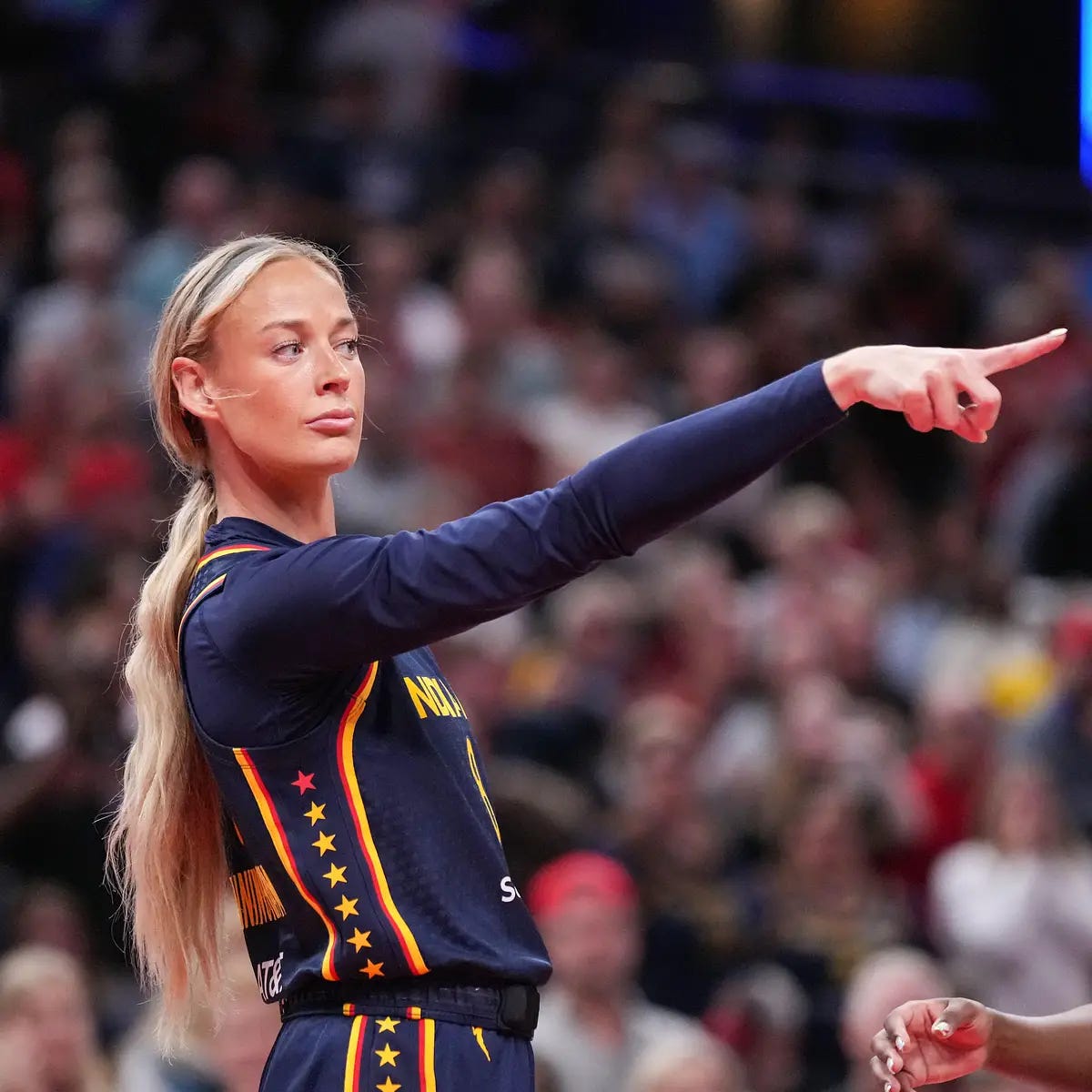
But Cunningham has proven she can appeal to the masses. As ESPN noted in the profile piece, Cunningham has 3.2 million TikTok followers, more than Caitlin Clark’s 1.1 million and four-time MVP A’ja Wilson’s 516,000.
If the WNBA wants to achieve its full potential, it should fire Cathy Engelbert and hire Sophie Cunningham as the first ever Player-Commissioner. By sheer force of personality alone, she would take the league to heights its never reached.
Cunningham’s job would be fourfold:
1.) Market the league.
Get out there everyday on traditional and social media and sell the league to the consumer. Sell the stories. Sell the product. Show America how great women’s basketball is. This seems obvious enough, but the WNBA has been doing very little in this department.
If Caitlin Clark puts up 45 and 10, which had never happened before in WNBA history, or if Marina Mabrey scores 53 tying the WNBA’s all-time points scored in a game record, which she did last month, that needs to be the lead on every sports talk show. The Commissioner needs to be out talking about it. She needs to be facilitating interviews with the player, her teammates, the coaches, maybe even the referees, marveling at what a performance it was. This is how you get people to tune in. It is not a coincidence that the Fever/Liberty game mentioned above brought in record viewers the day after Clark’s record-setting 45/10 game.
2.) Focus on Families.
The most important target demographic for the WNBA should be families with daughters (or even sons!) who play sports. Everything the WNBA does should be marketed to those potential customers. This is the “Caitlin Clark phenomenon” in a nutshell. Families (and dads especially) will go out of their way to take their kids to games. Make sure that the in-arena entertainment, the marketing campaigns, the ticket deals — everything — is oriented toward families.
3.) Get rid of the overt political messaging.
Players have freedom of speech and should be allowed to say what they want to say. Censorship is a bad idea. But the league itself should not be marketing itself as a “woke” league — this is unnecessary, it earns the league nothing, and it turns off millions of potential customers. The NFL and even the NBA learned this lesson already. You don’t have to tell the players to shut up and dribble, but you do need to message in a more corporate way that can appeal to everyone. Republicans buy sneakers, too.
4.) Start the regular season in April and start the playoffs in August.
Basketball reaches peak interest in the playoffs, not the regular season. The WNBA needs to take better advantage of the summer sports dead zone. This year, the season tipped off on May 8th and the playoffs begin on September 27th, right in the middle of football season. Cut the regular season down from 44 games to 40, start the season the first week of April, and start the playoffs the first week of August. Expand the first round to a best of five series, while keeping the second round at 5 games and the WNBA Finals at 7.
While the WNBA Finals would still overlap with football season, I think the league can make a bet on itself: market the first round heavily, get consumers really invested in the players and teams, and then watch what happens.
I want the WNBA to succeed. Most of these articles about how to improve the league are rage bait. That’s not what I’m trying to do here. During the World Cup, I found that I preferred watching women’s basketball to men’s soccer. I would watch a Tuesday night Liberty/Aces game over a Washington Nationals game. The WNBA is actually really good. It’s a joy to watch. Now it just needs leadership that believes in the product and will do what it takes to grow the league and allow it to thrive.
You have to be kidding. 🙃
I’m confused. What are we saving the league from?